🎉 Up to 70% Off Selected ItemsShop Sale

Six months' residence and travels in Mexico;
William Bullock was a showman, collector and naturalist. In 1809 he moved his growing collection of 'natural curiosities' from Liverpool to London, originally to Piccadilly and then to the 'Egyptian Hall', which housed around 32,000 objects of natural history, ethnography and archaeology. Bullock knew that novelty was the key to maintaining his audience and so in 1819 he auctioned his permanent collection and hosted temporary exhibitions instead. Two such exhibitions- titled Ancient Mexico and Modern Mexico- held in 1824, included artifacts and specimens brought back from his 1822 trip to Mexico. He 'spent six months collecting 'scientific information' that amounted to a vast array of flora, fauna, pre-Columbian manuscripts, sculptures and other artifacts' (Stephen, 157). In exhibiting these finds in England he became 'the first to present Mexican arts to the public in the post-independence period' praising in particular the 'productive industry' of rural folk art (Stephen, 157).
Includes 'The Plan of the City of Mexico', based on the celebrated map of Mexico City by Diego García Conde originally engraved in 1807. Extremely difficult to obtain because of its rarity and format, Conde's map, as found in this book, is an alternative way of acquiring an early version of the greatest nineteenth-century map of Mexico City.
FIRST EDITION.8vo., [2], v-xii, 532pp., with 2 folding engraved maps, folding table, 16 aquatint plates, 4 coloured by hand. Contemporary pale half calf, spine gilt in 6 compartments, green lettering piece, brown marbled boards and endpapers, a fine fresh copy.
Abbey Travel 666; Sabin 9140.
Lynn Stephen, Zapotec Women: Gender, Class, and Ethnicity in Globalized Oaxaca, Duke University Press (2005).
Includes 'The Plan of the City of Mexico', based on the celebrated map of Mexico City by Diego García Conde originally engraved in 1807. Extremely difficult to obtain because of its rarity and format, Conde's map, as found in this book, is an alternative way of acquiring an early version of the greatest nineteenth-century map of Mexico City.
FIRST EDITION.8vo., [2], v-xii, 532pp., with 2 folding engraved maps, folding table, 16 aquatint plates, 4 coloured by hand. Contemporary pale half calf, spine gilt in 6 compartments, green lettering piece, brown marbled boards and endpapers, a fine fresh copy.
Abbey Travel 666; Sabin 9140.
Lynn Stephen, Zapotec Women: Gender, Class, and Ethnicity in Globalized Oaxaca, Duke University Press (2005).
$1,099.93
Original: $3,666.42
-70%Six months' residence and travels in Mexico;—
$3,666.42
$1,099.93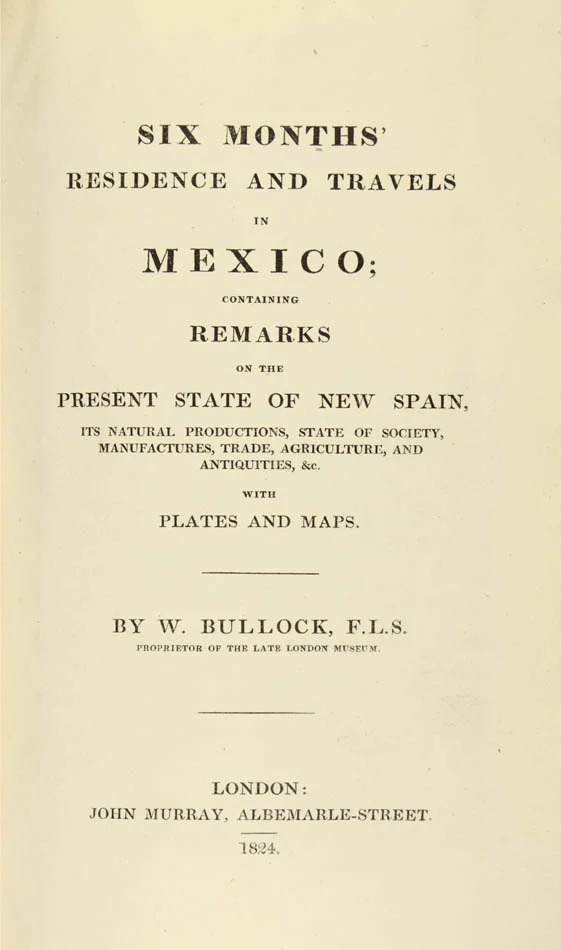
Description
William Bullock was a showman, collector and naturalist. In 1809 he moved his growing collection of 'natural curiosities' from Liverpool to London, originally to Piccadilly and then to the 'Egyptian Hall', which housed around 32,000 objects of natural history, ethnography and archaeology. Bullock knew that novelty was the key to maintaining his audience and so in 1819 he auctioned his permanent collection and hosted temporary exhibitions instead. Two such exhibitions- titled Ancient Mexico and Modern Mexico- held in 1824, included artifacts and specimens brought back from his 1822 trip to Mexico. He 'spent six months collecting 'scientific information' that amounted to a vast array of flora, fauna, pre-Columbian manuscripts, sculptures and other artifacts' (Stephen, 157). In exhibiting these finds in England he became 'the first to present Mexican arts to the public in the post-independence period' praising in particular the 'productive industry' of rural folk art (Stephen, 157).
Includes 'The Plan of the City of Mexico', based on the celebrated map of Mexico City by Diego García Conde originally engraved in 1807. Extremely difficult to obtain because of its rarity and format, Conde's map, as found in this book, is an alternative way of acquiring an early version of the greatest nineteenth-century map of Mexico City.
FIRST EDITION.8vo., [2], v-xii, 532pp., with 2 folding engraved maps, folding table, 16 aquatint plates, 4 coloured by hand. Contemporary pale half calf, spine gilt in 6 compartments, green lettering piece, brown marbled boards and endpapers, a fine fresh copy.
Abbey Travel 666; Sabin 9140.
Lynn Stephen, Zapotec Women: Gender, Class, and Ethnicity in Globalized Oaxaca, Duke University Press (2005).
Includes 'The Plan of the City of Mexico', based on the celebrated map of Mexico City by Diego García Conde originally engraved in 1807. Extremely difficult to obtain because of its rarity and format, Conde's map, as found in this book, is an alternative way of acquiring an early version of the greatest nineteenth-century map of Mexico City.
FIRST EDITION.8vo., [2], v-xii, 532pp., with 2 folding engraved maps, folding table, 16 aquatint plates, 4 coloured by hand. Contemporary pale half calf, spine gilt in 6 compartments, green lettering piece, brown marbled boards and endpapers, a fine fresh copy.
Abbey Travel 666; Sabin 9140.
Lynn Stephen, Zapotec Women: Gender, Class, and Ethnicity in Globalized Oaxaca, Duke University Press (2005).